
August 7, 2026
Wilderness Preservation: A Civic Responsibility
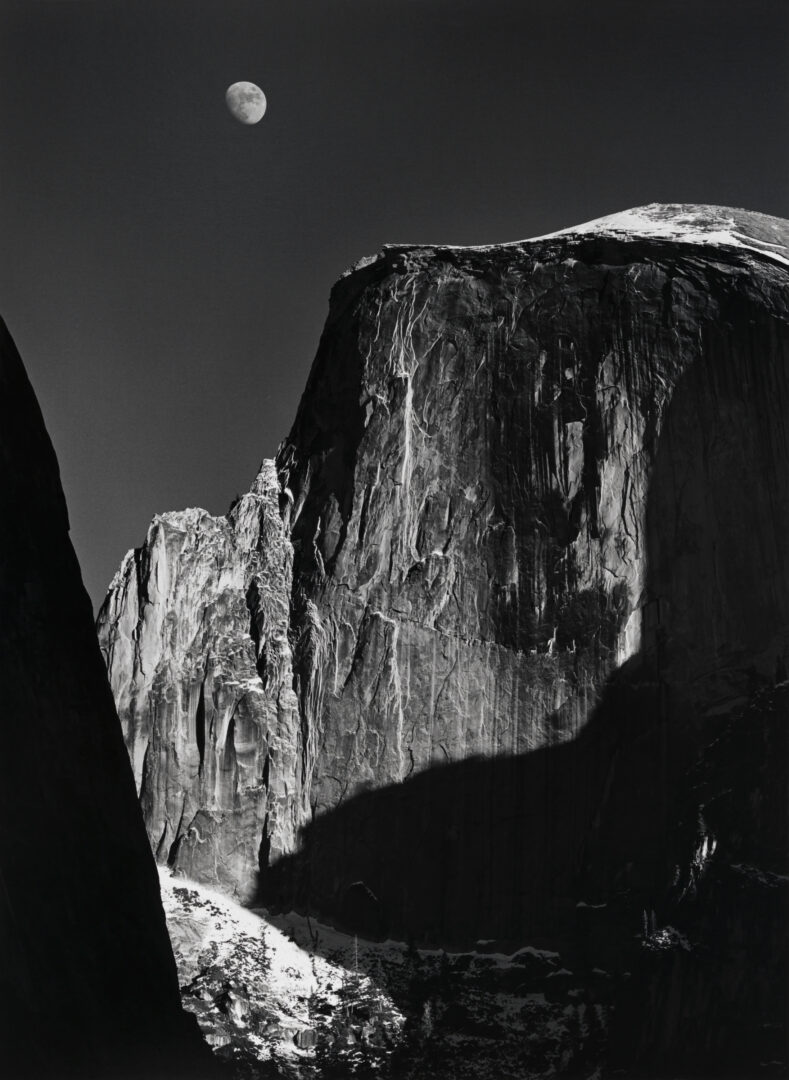
Ansel Adams (American, 1902–1984), “Moon and Half Dome, Yosemite Valley, California,” 1960, Gelatin silver print, Gift of Dr. and Mrs. T. Lane Stokes, 82.128
“National parks are the best idea we ever had,” said writer and historian Wallace Stegner. “Absolutely American, absolutely democratic, they reflect us at our best rather than our worst.”
Since its founding in 1890 and even before, Yosemite National Park has stood at the center of this democratic vision. The park’s cliffs, waterfalls, valleys, and towering trees inspired artists and conservationists who believed the American landscape could shape national values for the better. Figures like John Muir, Albert Bierstadt, Carleton Watkins, and Ralph Waldo Emerson introduced audiences across the country to Yosemite through their essays and images. Their work helped persuade Americans that wilderness preservation was not only an aesthetic mission to safeguard natural beauty, but also a civic one—a shared public responsibility to protect special places for future generations.
This tradition continued in the twentieth century in the photography of Ansel Adams. In Moon and Half Dome, Yosemite Valley, California (1960), Adams captures moonrise above the granite face of Half Dome, transforming the landscape into a careful arrangement of abstracted geometric forms. Adams’s black-and-white print emphasizes texture and atmosphere: velvety shadows dissolve into luminous highlights, while the smooth curvature of the moon balances the angular monumentality of the rock face. The resulting photograph feels both immense and intimate, combining precise formal control with a sense of quiet wonder. By crafting this view of Yosemite as a place that was magical, poetic, and shared, Adams continued the tradition of presenting the park as a site capable of inspiring collective reflection and civic responsibility.
Yet Yosemite’s history also reminds us that public lands have been shaped by cultural violence as well as cultural ideals. For thousands of years, the Yosemite Valley was home to Indigenous peoples including the Ahwahnechee and other Native communities of the Sierra Nevada region. During the mid-nineteenth century, many were forcefully displaced through the Mariposa War and the expansion of white settlement into California. The later preservation of Yosemite as public land thus emerged from a complicated history in which ideas of national belonging often excluded the very people who first called the valley home.
Today, Adams’s photograph in the Chrysler Museum collection reminds us that democracy depends not only on inclusive public elections, but also on the shared experiences that connect people to one another. Public lands create spaces where individuals from different backgrounds encounter the same rivers, mountains, and skies. Art, meanwhile, can help us recognize the value of those shared spaces—and our collective responsibility to protect them.
How do shared public lands shape your sense of wellbeing? What places feel meaningful because they belong to us all?
—Caroline Culp, Brock Curator of American Art