

July 21, 2026
The People’s Renoir
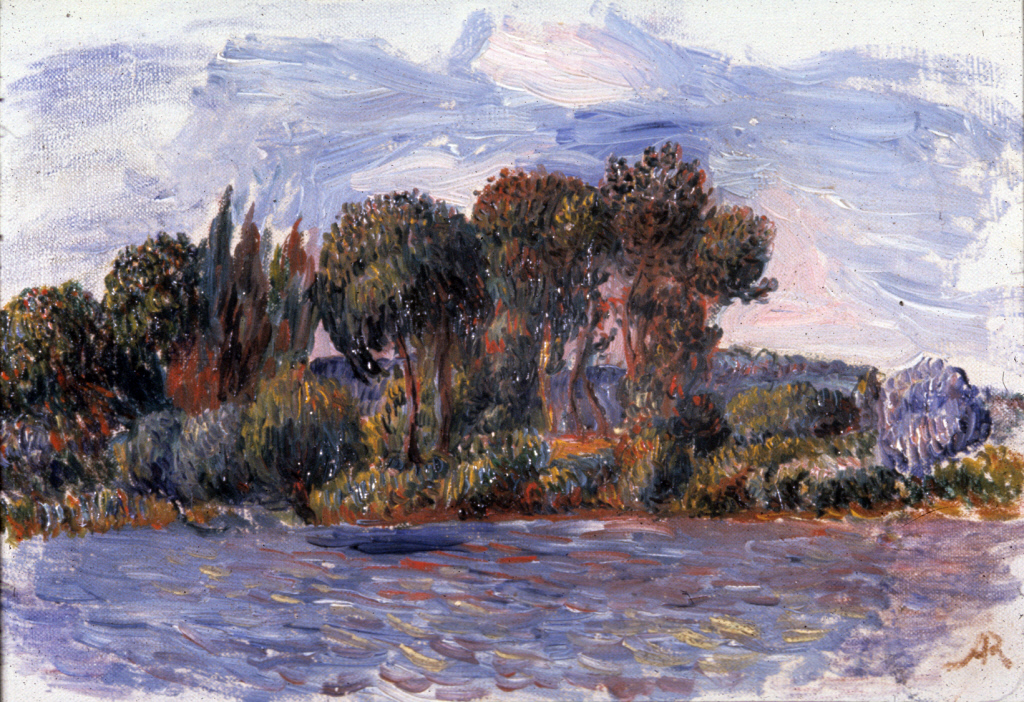
Pierre Auguste Renoir (French, 1841-1919), Trees by the Edge of a River, ca. 1875-1880, Oil on board, Museum purchase, Public Subscription, 67.96.1
This postcard-sized landscape painting by Pierre-Auguste Renoir depicts a tranquil scene of trees and shrubs along a river beneath a sky rendered in seemingly hasty strokes of blue, white, and pink. Despite its diminutive size and humble subject matter, the work possesses an outsized charm. Its bright colors evoke the joy of being in nature, while Renoir’s use of pinks and purples captures the delicate interplay of light that is a hallmark of French Impressionism. The painting’s significance is underscored by the fact that it was acquired directly from the artist by the renowned Paris art dealer Ambroise Vollard, one of the leading champions of modern European art.
At first glance, it may be difficult to see how this work relates to democracy, yet the story of its acquisition is one of collective civic action. In 1967, the then Norfolk Museum of Arts and Sciences launched an ambitious public subscription campaign to raise funds to purchase the Renoir. Inaugurated by Norfolk mayor Roy B. Martin Jr., the year-long effort drew nearly 20,000 contributors from across the community, ranging from prominent civic leaders to schoolchildren sacrificing their pocket money. Although the Museum’s collection of French art from this period has grown considerably in the decades since, this acquisition brought the institution’s first Impressionist painting to Norfolk and likely provided many in the community with their first encounter with this now-celebrated artistic movement.
For me, democracy means active participation in civic life, whether through voting in local, regional, and national elections or by volunteering for causes that strengthen one’s community. This painting serves as a vibrant reminder of the value our community places on the visual arts and the important role culture can play in enriching our lives. It also speaks to democracy’s capacity to inspire collective ambition. Although the contributors to the subscription campaign could not have imagined how the Museum would grow and transform in the decades ahead, they believed that together they could bring an important work of art to Norfolk and help lay a foundation for the future. They succeeded, leaving behind a legacy of civic commitment to the arts that remains as vibrant today as it was then.
—Mark Castro, Director of Curatorial Affairs