

October 15, 2026
Chrysler Museum of Art to Unveil Restored Tiffany Glass Window Panels Reunited for the First Time in 50 Years in Upcoming Exhibition
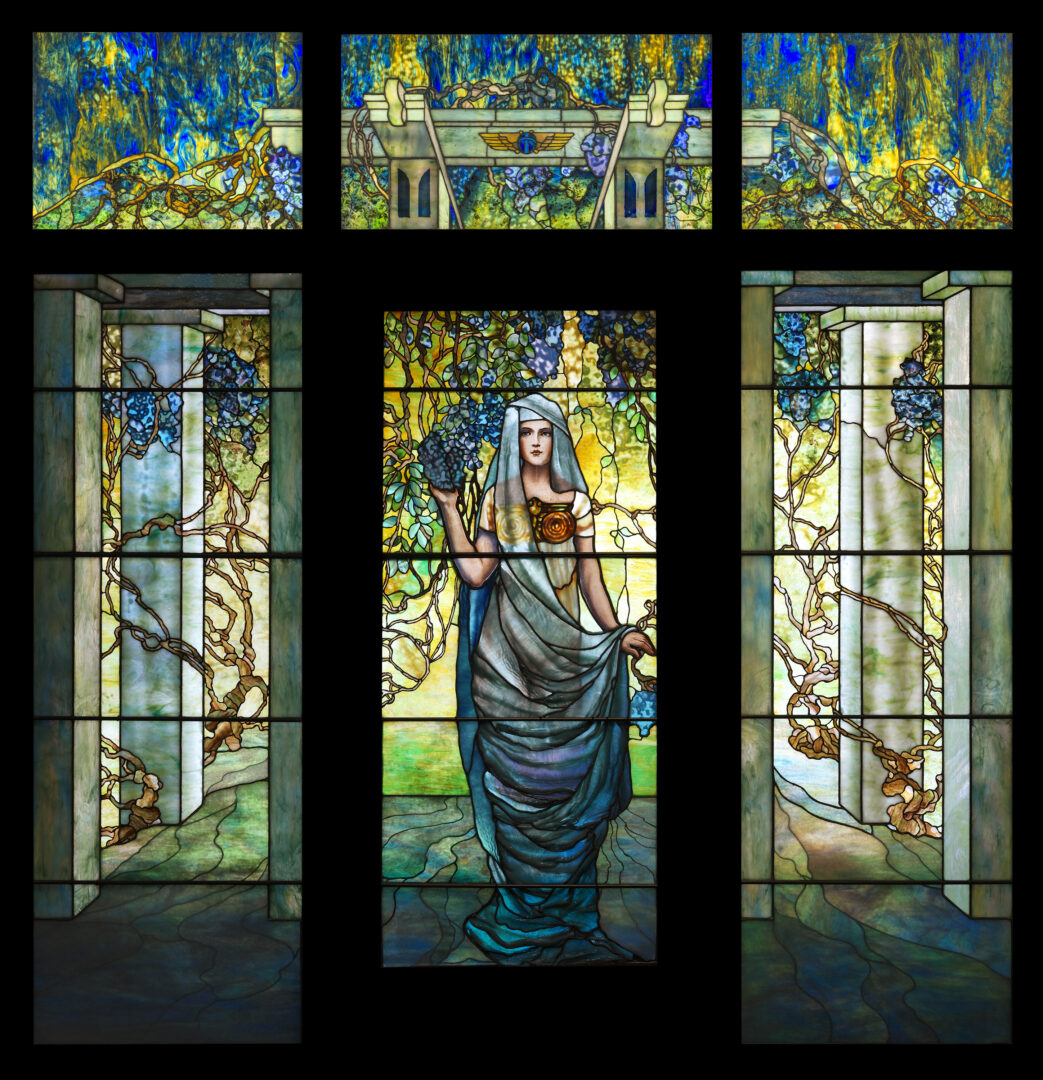
Tiffany Studios (American, 1902–1932), Woman in a Pergola with Wisteria, 1911, Leaded glass with copper foil, stain, and enamel, Chrysler Museum of Art, Gift of Walter P. Chrysler, Jr., 78.477, and Museum Purchase with Funds from the L. & J. Goldrich Foundation, 2025.71
NORFOLK, Va. — For decades, visitors to the Chrysler Museum of Art have admired “Woman in a Pergola with Wisteria” without experiencing the Tiffany Studios stained-glass window in its entirety or knowing the story behind the subject. For the first time in 50 years, the window will be joined by its three transom panels in “Woman in the Window: Tiffany’s Masterpiece Reunited,” on view Feb. 19-June 13, 2027.
The exhibition is the culmination of years of historical research and a cross-country recovery effort. Furniture, vases and other decorative items will transport visitors to Pembroke Estate, the Long Island, New York mansion where the window was first displayed. Archival letters, personal photographs, period attire and fine jewelry uncover the story of the woman depicted, world-renowned American opera star Lillian Nordica.
“For generations, visitors to the Chrysler Museum of Art have formed a deep emotional connection with this artwork,” said Erik Neil, Macon and Joan Brock director of the Chrysler Museum of Art. “Reuniting all six panels completes a central piece of our collection and ‘Woman in the Window: Tiffany’s Masterpiece Reunited’ celebrates both an extraordinary triumph in art conservation and a compelling narrative of romance and patronage.”
Captain Joseph Raphael De Lamar, a Dutch immigrant and millionaire, commissioned “Woman in a Pergola with Wisteria” around 1911. The panels were separated in 1968 when De Lamar’s estate was razed. Walter P. Chrysler, Jr. acquired three lower sections, gifting them to the Museum in 1978. The upper transoms remained unaccounted for until 2019 when researchers recognized them in online photos of a private residence in Arizona. The Chrysler Museum acquired the displaced sections and collaborated with conservators at The Metropolitan Museum of Art to repair and integrate the complete set.
“What makes this Tiffany window so extraordinary is that it represents Louis Comfort Tiffany at the absolute peak of his creative and technical output,” said Carolyn Swan Needell, Barry curator of glass at the Chrysler Museum of Art. “This work is particularly rare because it depicts an identifiable historic figure. Reconnecting the window with its missing transoms and shedding light on its subject allows us to share an important story of American decorative arts.”
“Woman in the Window: Tiffany’s Masterpiece Reunited” will present the reunited panels alongside Louis C. Tiffany’s watercolor design for the window. The exhibition offers a more in-depth view of the estate with plans for the property that were published in 1919 in The American Architect and Lawrence Alma-Tadema’s “The Sculpture Gallery” (1874), a painting that once hung in De Lamar’s living room. Furniture; dinnerware, lamps, clocks and luminaries from Tiffany & Co.; and vases produced by Tiffany Furnaces offer insight into the decorative arts that adorned De Lamar and Nordica’s homes.
It was long assumed that the subject in “Woman in a Pergola with Wisteria” was modeled after Nellie Virginia Sands De Lamar, De Lamar’s ex-wife. Her portrait, painted in 1896 by Théobald Chartran is included in the exhibition as well as several portraits of Nordica painted by Hermann Schmiechen in 1878 and Samuel Burtis Baker in 1911.
Nordica’s official photograph revealed that the robed female figure set beneath flowering vines in the window was the famed opera singer costumed as the heroine of Giuseppe Verdi’s “Aïda.” De Lamar maintained a passionate friendship with Nordica and asked for her hand in marriage in 1874 and again in 1905. Although Nordica declined both proposals, De Lamar immortalized his lifelong devotion in glass.
A letter from Nordica to De Lamar in the exhibition provides a window into their friendship. The exhibition also celebrates Nordica’s career with the score from “Aïda” signed by Nordica and her feature on the cover of The New York Times Sunday Magazine, published Dec. 12, 1896. Costumes and jewelry that Nordica wore in “Aïda,” “Tristan and Isolde,” “Parsifal” and other productions transport visitors to the stage of some of the eras most-beloved operas while a Louis Vuitton trunk offers a window into her time on the road. The exhibition also highlights her influence off stage as an endorser for several brands, including Coca-Cola, with a 1905 advertisement for the beverage company along with the ostrich feather fan Nordica holds in the ad. She was the first celebrity endorsement in a print ad campaign for Coca-Cola.
Several works in the exhibition demonstrate the connection between performance and art. Dancer and choreographer Isadora Duncan features prominently in several works in the exhibition, including an art deco vase by André DeLatte, an elegant pâte de verre depiction of her dancing by Jean Descomps and Abraham Walkowitz’s “Five Watercolors of Isadora Duncan in Various Dance Poses.”
“Woman in the Window: Tiffany’s Masterpiece Reunited” is accompanied by a catalog of the same name. Essays by Needell detail the window’s history; the accidental discovery of the lost transoms; and its architectural, artistic and social context. Opera historian Caleb Eick, of The Sembrich in Bolton Landing, New York offers insight into Aïda’s history and audience reception, and Jacqueline Tsang, research fellow at Macklowe Gallery in New York City considers the relationship between contemporary performance and decorative arts.
The complete six-part window will be displayed alongside its original concept sketch in “Designing the Gilded Age: Drawings from the Studios of Louis C. Tiffany” at The Metropolitan Museum of Art Oct. 19, 2026-Feb. 7, 2027.
“Woman in the Window: Tiffany’s Masterpiece Reunited” is presented by Connie and Marc Jacobson, organized by the Chrysler Museum of Art and curated by Carolyn Swan Needell, Barry curator of glass. The transom windows were purchased with funds from the Jan and Larry Goldrich Foundation.
###
ABOUT THE CHRYSLER MUSEUM OF ART
The Chrysler Museum of Art welcomes you to connect with art, creativity and our shared humanity. Internationally recognized for its collection of more than 35,000 objects, including one of the largest glass collections in America, the Museum offers free admission; includes the state-of-the-art Perry Glass Studio, a full-service restaurant, shop, theater and works on paper space; and oversees the historic Myers House. The Museum boasts an ambitious schedule of exhibitions, events and programs and has been nationally recognized for its commitment to inclusion through its innovative gallery host program. For more information, visit chrysler.org. Follow on social media @ChryslerMuseum to receive the latest updates.
Media Contact:
Adrian Lilly
Blue Water Communications
800-975-3212
info@bluewatercommunications.biz
High-resolution images and credits are available. Permission and credit are required for the use of all images, print or digital. Cropping may not be permitted on some images; see caption sheet if applicable.