

July 22, 2025
Chrysler Museum Celebrates Susan Watkins and her Contemporaries in Fall Exhibition
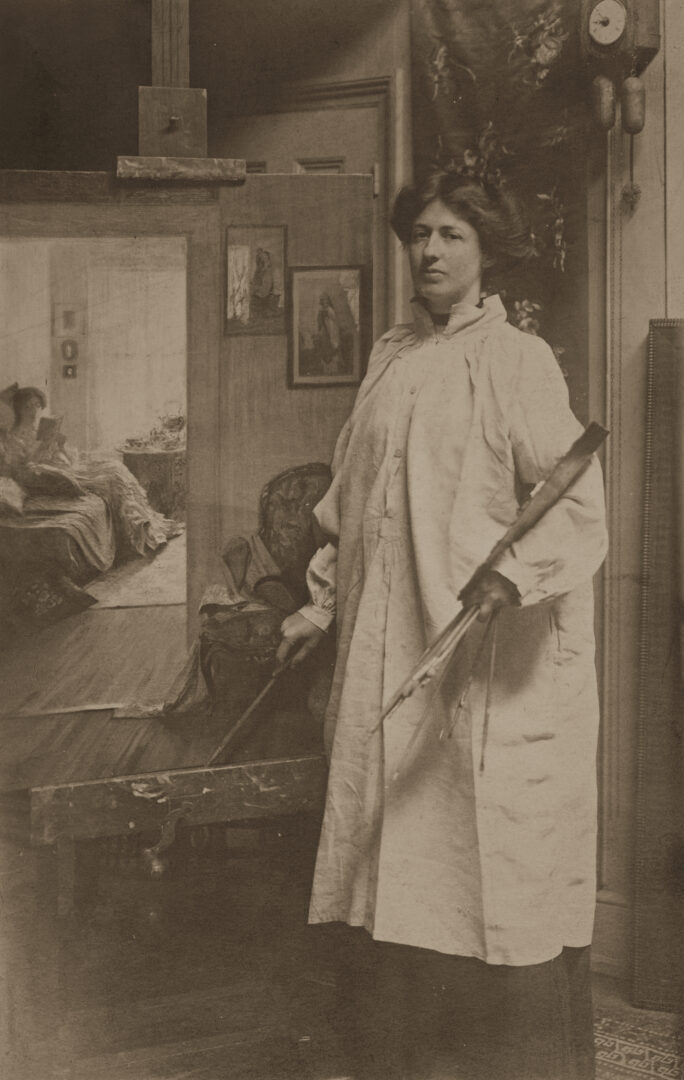
Edwin Scott Bennett (American, 1847–1915), Susan Watkins in Her Studio, ca. 1910, Gelatin silver print, Jean Outland Chrysler Library, Chrysler Museum of Art
NORFOLK, Va., July 22, 2025 — Journey to a transformative period in American art and celebrate the talent, resilience and impact of artists who were often overlooked in “Susan Watkins and Women Artists of the Progressive Era,” on view Oct. 17, 2025-Jan. 11, 2026, at the Chrysler Museum of Art. Organized by the Chrysler Museum of Art, the exhibition features approximately 75 works by more than 20 artists, including Susan Watkins, Lilla Cabot Perry, Minerva Chapman and Anna Elizabeth Klumpke.
This year marks the 150th anniversary of Susan Watkins’ birth, and her remarkable achievements anchor the exhibition. Watkins (1875-1913) exhibited regularly at the Paris Salon and earned praise from American art press, both uncommon for women artists of the late 19th and early 20th centuries. Her career was steeped in the values of her time yet defined by her distinctly personal vision. Though the American painter’s life ended prematurely at age 38, her story offers a compelling window into the social and professional context of the transatlantic artistic world that shaped her and her contemporaries.
“‘Susan Watkins and Women Artists of the Progressive Era’ provides a fresh perspective on a transformative moment in American art history,” says Corey Piper, Ph.D., the Chrysler Museum’s Brock curator of American art. “This exhibition highlights the innovation and determination of Watkins and her peers, who forged remarkable careers despite the barriers they faced. By showcasing their work, we hope to inspire a deeper understanding of their impact and to broaden the narrative of American art to include these long-overlooked contributions.”
“Raphaël Collin and His Female Students in His Atelier, Paris” (ca. 1899) greatly influenced the trajectory of the exhibition. The albumen print held in the Chrysler Museum’s collection depicts Watkins with other women artists who sought professional studies during a time when many prestigious art institutions in Paris denied women admission, charged them higher tuition or restricted them to all-female classes. In the image of approximately three dozen students, only Watkins, French painter Madeleine Smith and the instructor have been identified. The other women pictured remain unknown.
“As I looked at this photograph, I began thinking more broadly about Susan Watkins not just as an individual but in the way she fit into a larger network of women who were pursuing artistic careers at a scale that had never happened in the United States. I hope this exhibition will introduce visitors to talented artists who may not be household names but produced exceptional work,” said Piper.
Academic institutions in Paris played a vital role in fostering professional opportunities for Watkins and other women from the United States. However, their pursuits were met with anxiety and disapproval from Americans who feared the women were being exposed to values deemed too permissive in the United States. After completing professional training, many women also faced an evolving societal landscape.
“As soon as many of these women made it to the table, the rules changed,” explained Piper. “The academic path they pursued was replaced with a bohemian lifestyle and the expectation to live as a ‘starving artist,’ a practice that was difficult for women of that era to adopt. The shift excluded women from the professional sphere, causing their contributions to be overlooked in some accounts of art history.”
“Susan Watkins and Women Artists of the Progressive Era” is organized in five sections, tracing Watkins’s artistic journey alongside the broader contributions of women artists. The first section, “Academic Pursuits,” explores the role of training institutions in launching women’s careers. Next, “American Artists on an International Stage” highlights strategies women used to gain recognition, such as exhibiting at the Paris Salon. Watkins showed her work at the Salon for 11 consecutive years. “Interiority and the Psychology of Spaces” examines the domestic spheres as spaces of creativity, while “Portraits and Artistic Networks” highlights how portraiture served as a means of professional advancement. The final section, “An Artist Abroad,” explores how Watkins eventually navigated beyond the studio, painting European landscapes and urban scenes.
While letters and other writings from Watkins are scarce, her art offers insight into her perspective and professional acumen. “Woman Playing a Guitar” (1901) is a notable departure from the flirtatious portrayals of women with musical instruments that were popular during that time. Instead, the woman in Watkins’ work is intently focused on her craft, exuding both skill and professionalism. Shortly after completing the work, Watkins sat for a photograph portrait in front of the painting. The portrait, held in the Chrysler’s collection and included in the exhibition, emphasizes the significance of the work for the artist. The traveling exhibition also offers a rare opportunity to introduce her work to new audiences through a compelling selection of sketches, portraits and landscapes highlighting her artistic range. Among the collection is “The 1830 Girl,” a masterpiece that earned Watkins a third-class gold medal at the 1901 Paris Salon, an incredible honor for an American artist, and an even rarer achievement for an American woman working in France.
A 60-page scrapbook housed in the Chrysler Museum’s library further demonstrates Watkins’ business savvy and dedication to her art career. This extensive collection of newspaper clippings was likely compiled through a popular subscription service that mailed individuals any press mentions of their name. She also invested in professional reproductions of works.
“Susan Watkins had an intense determination to succeed as a professional artist. That dedication and drive mirror the persistent effort required of artists even now,” said Piper.
Many of Watkins’ paintings have long been fixtures in the Chrysler Museum’s collection. After marrying Goldsborough Serpell, a Norfolk banker, Watkins lived less than a mile from the Chrysler Museum of Art. Following Serpell’s death in 1946, the Museum received a generous bequest of Watkins’ paintings and drawings and a substantial archive of personal papers and photographs. This gift formed the foundation of the Museum’s early holdings in American art. For this exhibition, Piper connected with Serpell’s descendants to secure loans of several of Watkins’s works that had remained in private hands.
“The Chrysler has served as a steadfast steward of Watkins’ legacy, presenting her work in exhibitions over the decades,” said Erik Neil, the Chrysler Museum of Art’s Macon and Joan Brock director. “‘Susan Watkins and Women Artists of the Progressive Era’ marks the first major effort to reintroduce Watkins to a broader national audience since her lifetime, offering fresh perspectives through innovative scholarship and a richly illustrated catalogue.”
“Susan Watkins and Women Artists of the Progressive Era” will be complemented by a companion publication of the same title co-published by the Chrysler Museum of Art and Yale University Press with support from the Wyeth Foundation for American Art. The illustrated catalogue includes thematic essays exploring Watkins’s work and the opportunities for women artists in France and the U.S. with contributions from leading scholars Alexis Boylan, Emily C. Burns, Michelle Green, Crawford Alexander Mann III, Corey Piper and Jillian Russo.
The traveling exhibition is currently on view at Dixon Gallery and Gardens in Memphis, Tennessee through Sept. 28.
“Susan Watkins and Women Artists of the Progressive Era” is organized by the Chrysler Museum of Art and supported, in part, by the National Endowment for the Arts.
ABOUT THE CHRYSLER MUSEUM OF ART
The Chrysler Museum of Art brings art and people together through experiences that delight, inform and inspire. Internationally recognized for its collection of more than 35,000 objects, including one the largest glass collections in America, the Museum also includes free admission, the state-of-the-art Perry Glass Studio, a full-service restaurant, shop, theater, works on paper space, and oversees the historic Myers House. The Museum boasts an ambitious schedule of exhibitions, events, and programs, and has been nationally recognized for its commitment to inclusion through its innovative gallery host program. For more information, visit chrysler.org. Follow on social media @ChryslerMuseum to receive the latest updates.
####
For more information or interview assistance, please contact:
- For National Outlets, contact Adrian Lilly, BlueWater Communications | 800-975-3212 | adrian@bluewatercommunications.biz
- For Regional and Local Outlets, contact Tanya Kaish Keller, Public Relations Consultant | 757-618-3655 | mejanepr@gmail.com
High-resolution images and credits are available. Permission and credit are required for the use of all images, print or digital. Cropping may not be permitted on some images; see caption sheet if applicable.